Twenty years ago, a persistent if not widespread public outcry arose over the colorization of old black and white movies. Although Ted Turner (at the time having just purchased MGM for the sole purpose of exploiting its film library) was the most prominent perpetrator of this heresy, he was not the only one that tried to "update" what colorizers thought everyone else would think were musty old unwatchable monotone flicks. In response to the outcry, as well as to the fact that colorization did not end up being the boon that the colorizers thought it would be, the practice thankfully disappeared after only a couple of years.
In the past several years, a similar and equally insidious practice has emerged in regards to the supposed updating of old movies and TV programs. I'm referring to the addition of CGI elements to revise media texts that were created before the advent of compuer generated imagery. The rationale is that the creators of these texts would have utilized the creative possibilities of CGI in their original creation, had it been at their disposal when the movies or TV shows were first made. One of the reasons that this rationale is so clear is that in most cases it is the original creators that have decided to make the alterations to their films and programs.
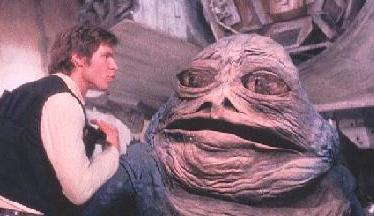
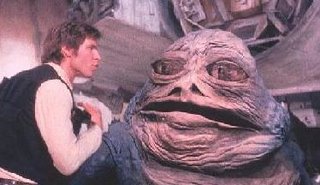
As he has in so many other ways, George Lucas led the way in terms of the digital "revision" of old movies. The first significant CGI updating of a body of work was with Lucas' "Star Wars" trilogy "Special Edition" theatrical rereleases that appeared in 1997. Lucas, famously a perfectionist and a stickler for technical detail, felt that the new digital technology would allow him to create enhancements such as new backgrounds, more elaborate alien characters, and more complex spaceships and outer space settings that were impossible with the state of late-1970s and early-1980s cinematic art. These modifications included adding a digital (and mobile) Jabba the Hutt to a previously unused docking bay scene in "Star Wars" (pictured in the above still image), additional exotic beasts of burden and cityscape improvements in the desert setting of the planet Tattooine in the same film, and similar cityscape improvements to Cloud City in "The Empire Strikes Back." These changes in the original trilogy, besides sprucing up scenes that Lucas thought needed it, were a shakedown of the digital technology that he would subsequently use (much, much more extensively) to finally make the "Star Wars" prequel trilogy that was completed last year.
Lucas' sometime collaborator Steven Spielberg also did a digital revamp of his film "E.T. The Extra Terrestrial" on its 20th anniversary in 2002. The modifications made by Spielberg were not as extensive, but they were more gratiuitous. The most famous of these was in the scene in which the police are chasing the children, where the guns the police are carrying were replaced with walkie talkies.
The most recent example of the use of CGI to update old media texts (and the first that I've heard of involving a TV program) has occurred this fall with the rerelease to syndication of the original "Star Trek" series with a host of new CGI effects. New background elements, an extensively modified exterior to the Starship Enterprise, and redone battle scenes and shots of space are the reported changes to the venerable sci-fi show. Supposedly, Paramount Studios, the caretaker of the "Star Trek" legacy, has taken pains to stay true to "Trek" creator Gene Roddenberry's vision.
So what is the big deal about the modification of old movies and TV shows in this way? The big deal is that they are revisionist in a way just as damaging as the specious rewriting of history to reflect current trends or the government's shifting rationale for public policy in light of ongoing developments. A truly honest and forthright government needs to be transparent about the reasons for its policy on everything from national defense to disaster management. History has to strive for complex understanding of the meaning and import of the past, not ensure that what happened in the past is not going to offend anyone in the present. And all kinds of artistic texts from the past, whether a movie or a sonnet, should be left intact in the form in which they were created. If not, we run the risk of losing an understanding of the cultural values and mores displayed, the historical values of artifacts seen or described, and the integrity of the formal qualities of artistic texts. Revising a movie or a TV program years after the fact with new elements such as computer imagery just because it is suddenly technologically possible is no different or more acceptable than using acrylic paint to touch up the odd contours of the face of the "Mona Lisa," updating the arcane language of a Shakespeare play, or restoring synthetically sculpted arms to the Venus de Milo.
Perhaps my comparison elicits a snicker or two due to its seeming absurdity. The "Star Wars" movies and the "Star Trek" programs are, after all, only thirty or forty odd years old right now, a mere drop in the chronological bucket compared to something like the "Mona Lisa" or "The Merchant of Venice." However, just as those artistic works are now for us a window into the Renaissance and its culture, rest assured that "Star Wars" and "Star Trek"--as hard as it might be to believe today--will equally be a window into late-20th century culture for those that will seek to understand it a few centuries from now.
At the root of Lucas' and Spielberg's and Paramount's itch to redo their work are several, mostly understandable factors. First is the fact that all of the examples I have been discussing are from the genre of science fiction. Science fiction has always been a form that looks to the future, and when moving-image sci-fi works no longer look so much like they are from the future it can be disconcerting. Already, only a few decades removed from their origin, due to the rapid changes in technology in real life in those decades, there's no denying that texts like "Star Wars" and especially the original "Star Trek" do look outdated, much less futuristic. This urge to update is another factor in the phenomenon of digital desecration. From the '60s togs in "Trek" to the '70s dos in "Star Wars," these films and programs already--even though they are science fiction, a genre that most of us don't think of as being thus--serve as documents of their times.
But this is precisely the point. We need for these, and all, artistic texts to be exactly that, documents of the times in which they were created. The chief objection to the colorization of movies in the 1980s was that it represented a diversion from the intentions of their creators. The fact that it is the creators of the texts that are now making the digitally-inspired changes doesn't make it forgivable; the creators' intentions were what they were when they created these works, and that doesn't change because their intentions might be different if they were creating the same works today.
Another understandable factor for the "new colorization" is need for the owners of these bodies of work to make them continually lucrative. Let's face it, as much as we believe that films and (to a much lesser extent) television programs are works of art, they are also equally works of commerce. In this age of the "long tail" when it comes to music and moving images, movies and such can continue to be assets with ongoing value for many, many years. It behooves their creators and owners to ensure that they will continue to be marketable. Even though CGI alterations may not end up being any more long lasting than colorization was, right now such updates are in some cases thought to be necessary.
My guess is that twenty years from now we will look back at the trend towards CGI modifications the same way that we now look back on colorization. Although potentially damaging, as long as the "original" works are not irreversibly changed, we can still enjoy them the same way that we can still enjoy the black and white "It's a Wonderful Life" even though it was at one time (utterly inexplicably) colorized. And as morbid as it might sound, eventually Lucas and Spielberg will die and won't be able to continue meddling with their own work in understandable but still misguided attempts to improve it. Until more time has passed, though, the most we can hope for is that "Star Wars" Special Edition DVDs will languish unsold on store shelves and the 21st-century "Star Trek" will go unwatched.
(Image source: www.scifimoviepage.com)

 available for those interested in seeing more of the actual show.